

If you’re like the guitarists at Sweetwater, one of the first questions you ask when a buddy tells you they bought a new guitar is this: “What kind of pickups you got in that?” Because we all know that, when it comes to electric guitars, the pickups are the sound. Humbuckers, single-coils, P90s, PAFs — there are a million pickup flavors for every type of guitarist. In this article, we take a look at the science of guitar pickups: what they do, how they do it, and why such a seemingly simple component can come in so many vastly different variations.
What Is a Guitar Pickup?
At its most basic, a guitar pickup comprises one or more magnets inserted into a bobbin and wound with conductive wire. This simple device transforms mechanical energy (string vibrations) into electrical energy, which flows into your guitar amp where it is transformed back into mechanical energy as sound waves.
Well, that tells us what a pickup does, but it doesn’t explain how it does it. To understand that, we have to travel back in time to 1831, when a self-taught English scientist named Michael Faraday discovered the principles of electromagnetic induction.
The Discovery of Electromagnetic Induction
Faraday, a tireless experimentalist, theorized that electricity could be generated from magnetism, a process referred to as electromagnetic induction. To demonstrate his theory, he connected a paper cylinder with wire coiled around it to a galvanometer, an instrument that detects small electrical currents. Then, Faraday moved a magnet in and out of the cylinder, and — lo and behold — a current was generated!
Electromagnetic induction is the production of an electromotive force in a wire as it passes through a magnetic field. So, in the above example, if the magnet is placed in or near the coil but is held static, then no current is produced. But when the magnet moves, the changing magnetic field passing through the coil generates an electrical current. The inverse is also true. The magnet can be held stationary and the wire can move through the magnetic field to generate a current.
Faraday’s discovery of induction, which was later mathematically described by Scottish physicist James Clerk Maxwell, is at the heart of countless technologies that forever altered human civilization, including the electric generators and transformers that power our daily activities.
But, let’s get back to what really matters here: guitar pickups!
Two Schools of Thought: Magnet-centric Model and String-centric Model
So, we’ve got a magnet (or magnets), a coil, and vibrating strings to affect changes in the magnetic field — everything we need to create an electrical current to feed our amplifier. Yet, in the pickup-building community, there seems to be some dispute over how the magnetic field is being affected.
There are two prevalent theories: the magnet-centric model and the string-centric model.
Common sense might prompt us to accept the magnet-centric model, which posits that when a vibrating string passes through the magnetic field produced by a guitar pickup’s pole pieces, it disturbs the field, creating magnetic flux that, in turn, generates a current. But common sense also tells us we shouldn’t always trust common sense!
Endorsed by the National High Magnetic Field Laboratory and renowned pickup makers such as PAF-inventor Seth Lover, the string-centric model may be the more accurate interpretation of how a pickup produces an electrical current. In this model, the string itself is magnetized by pole pieces, and, in vibrating, it generates its own dynamic magnetic field. This means that the coil does not necessarily need to wrap around the magnet, it only needs to magnetize the strings, which could be accomplished by holding the magnet above the strings. We’re all for alternative guitar designs at Sweetwater, but that one would be a little weird!
We’ll leave it up to the scientists to make the final call, but, whether it’s according to the magnet-centric model or the string-centric model, a pickup works by converting string vibrations into electrical energy, which can be amplified into some truly gnarly guitar tones!
Why Do Different Pickups Produce Different Tones?
So, on their face, pickups are pretty straightforward, right? But it begs a question. “Why do different pickups have drastically different tones?” The answer to that lies in the untold deviations that can be made to a pickup design, including the types of magnets you use, the number of windings in the coil, the amount of space between windings, the height or width of the bobbin, and on and on. So, like much of art and science, the principles are simple, but they open up nearly limitless possibilities.
Let’s take a look at some of the factors that affect a pickup’s tone.
Single-coil vs. Humbucking Pickups

So far, the pickup we’ve been describing is a classic single-coil pickup design, which consists of six magnetic pole pieces, a coil, a bobbin, and an output wire. Single-coil pickups are known for their bright tone, which has made them a favorite of legendary soloists such as David Gilmour, Eric Clapton, Stevie Ray Vaughan, and countless others. However, drawbacks to single-coil pickups include generally lower output levels and a susceptibility to hum and electromagnetic interference. Modern designers have developed very effective work-arounds for those issues, but, back in the day, the solution was to develop a pickup with higher output and greater noise rejection. Thus, the humbucking pickup was born.

The humbucker is a dual-coil pickup. The first coil is essentially the single-coil design we’re familiar with, and the second coil has its pole pieces inverted, with the south poles facing up. Traditionally, the coils are wired in series (though that’s not always the case) but out of phase. The humbucker design increases output by strengthening the magnetic field and summing the voltages created by the string vibrations (two are better than one!), and it creates an inverse phase relationship between the two coils that cancels out noise interference. The result is a hotter and quieter pickup with a darker top end and an aggressive bite. Few guitar pickups are more iconic than Seth Lover humbuckers, which he originally designed for Gibson in 1955 and have seen numerous reiterations — including these from Seymour Duncan — over the last eight decades.
Which is better, single-coils or humbuckers? The fact that they are both as popular as ever shows that neither is better or worse. As with most devices used in music making, it really comes down to a matter of personal preference. And within the realms of those two basic designs, a wealth of tonal diversity exists. Just take a look at the hundreds of guitar pickups offered at Sweetwater to see what we mean!
Common Types of Magnets Used in Pickups
A crucial factor in determining the tonality of a pickup is the choice of magnet used in its design. For guitar pickups, we primarily see three types of magnets employed: ceramic, alnico, and, to a lesser extent, neodymium.
By far the most popular choice for guitar pickups, alnico is a family of alloys composed mainly of iron, aluminum, nickel, and cobalt. Alnico alloys are ferromagnetic — meaning they can be magnetized, and they permanently hold their magnetism.
As an aside, materials used to make electric guitar strings, such as steel, nickel, and cobalt, are also ferromagnetic but not permanently magnetic — hence, the string-centric model of how a pickup works that we discussed earlier.
Alnico magnets come in several types — Alnico II and Alnico V magnets are probably the most common — that vary in terms of composition and magnetic strength and have distinct sonic differences. For instance, Alnico II magnets are more closely associated with “vintage sounding” guitars, having pronounced mids, smooth highs, and overall lower output compared to Alnico V. Alnico V magnets offer tighter lows, slightly scooped mids, and a spacious, chiming top end.
Ceramic magnets are less expensive than alnicos, and, because of that, there is sometimes a false perception that they are lower quality. But, again, they’re not better or worse, just different. Across the board, ceramic magnets are extremely strong, resulting in hotter pickups than similar alnico pickups. Hard rock and metal guitarists in particular are drawn to the forceful sound of ceramic pickups, which can teeter on being strident when played cleanly but add enhanced articulation to high-gain guitar tones.
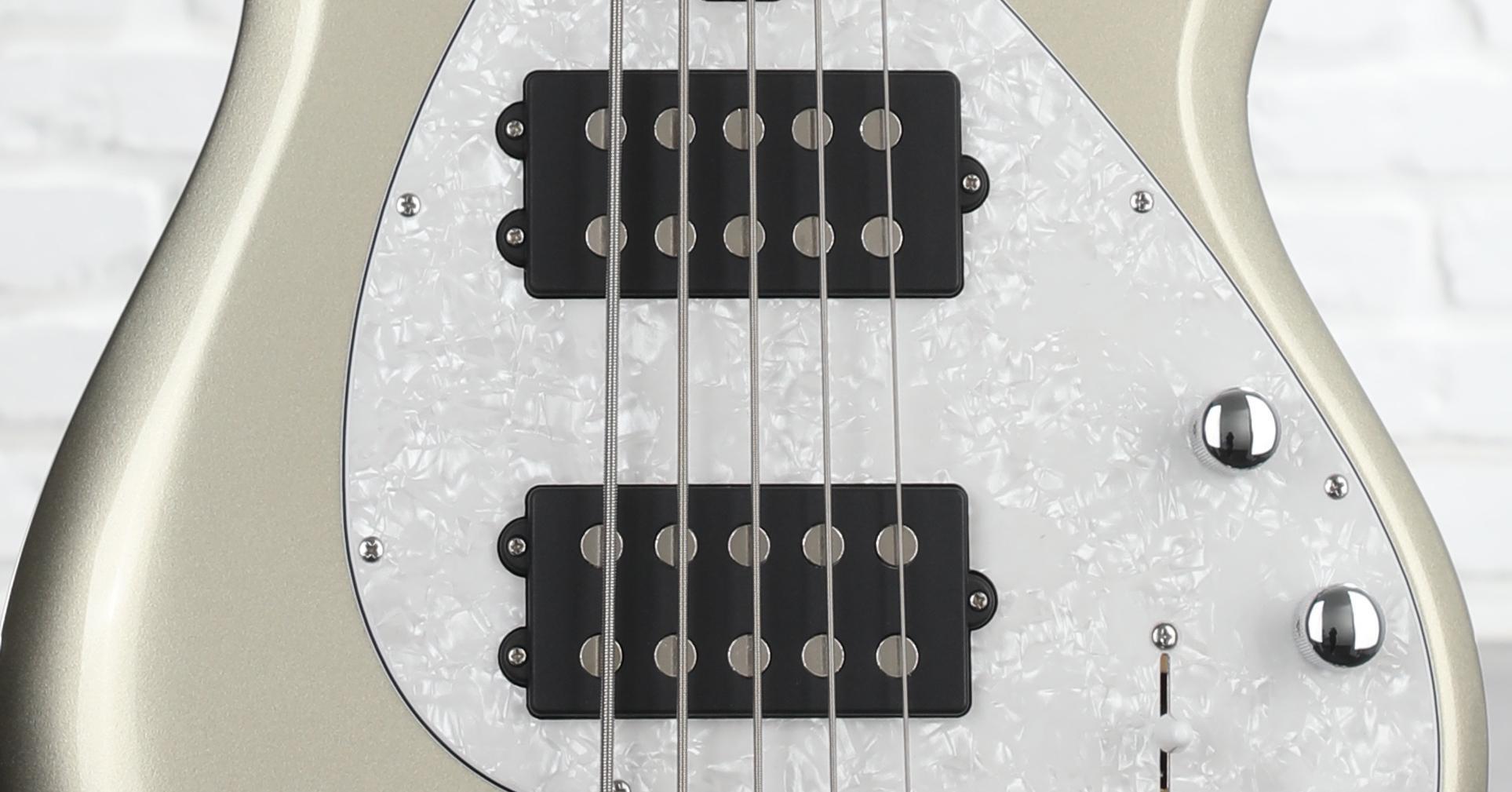
Stronger than both alnico and ceramic magnets, neodymium magnets are increasingly being employed in pickup designs. Because of their powerful magnetic field, neodymium magnets are excellent at capturing the pure sound of an instrument. But, the strength of neodymium can sometimes be too much for passive instruments. However, manufacturers such as Ernie Ball Music Man have found that neodymium magnets in an active pickup system absolutely crush it when it comes to producing killer bass tones — just check out the Ernie Ball Music Man StingRay Special!
Coil Winding, Bobbins, and Potting
Many pickup makers argue that coil winding is where pickup making becomes an art form. How a coil is wound has a huge influence on the tone of a pickup, affecting its frequency response, clarity, and output. A typical pickup coil can consist of thousands of winds, hundreds of feet of thread-like copper wire, which can be coated in enamel, polyurethane, polyurethane nylon, formvar, and other materials. The highest-quality pickups are hand-wound by a highly trained craftsperson who guides the wire as it wraps around the magnets to ensure an even distribution and tight coil spacing. If a pickup is underwound, it will have a thin, anemic tone; if it’s overwound, it will sound muddy and indistinct. Within that range are myriad tonal variations and output levels that give pickups their distinctive characteristics.
Bobbins are non-conductive and, therefore, have no effect on electromagnetic induction, but they do help to determine the surface area of the coil, which also impacts tone. For instance, P90s are single-coil pickups, but their sound — which lies somewhere between a Strat-style single-coil and a PAF-style humbucker — is due, in part, to the shape of their bobbin. The distance between the top and bottom flats of the bobbin, as well as the length of the pole pieces, also influences tone. Taller coils tend to produce cleaner and brighter tones, while shorter coils produce thicker and more well-rounded tones.

Another term you might come across when looking into pickups, particularly high-end pickups, is “potting.” When a pickup is potted, it is dipped in wax or lacquer to fill in any air gaps in the pickup coil. Gaps between windings can lead to unwanted noise and interference because the copper wire is allowed to vibrate. In some cases, a pickup’s coil may be so loosely wound or contain so many gaps that it can literally pick up sounds like a microphone, which is why those noises are often referred to as microphonics.
Conclusion
This article only scratches the surface of the science and artistry behind guitar-pickup design and manufacturing. It’s a fascinating topic worth exploring for any guitarist that wants to have a better understanding of their instrument and how they relate to it. And, if you want to continue the discussion and try out some new pickups, reach out to your Sweetwater Sales Engineer at (800) 222-4700. We’re not sure if you’ve noticed, but we’re pretty geeky here, and we’d love to talk pickups with you anytime!

